
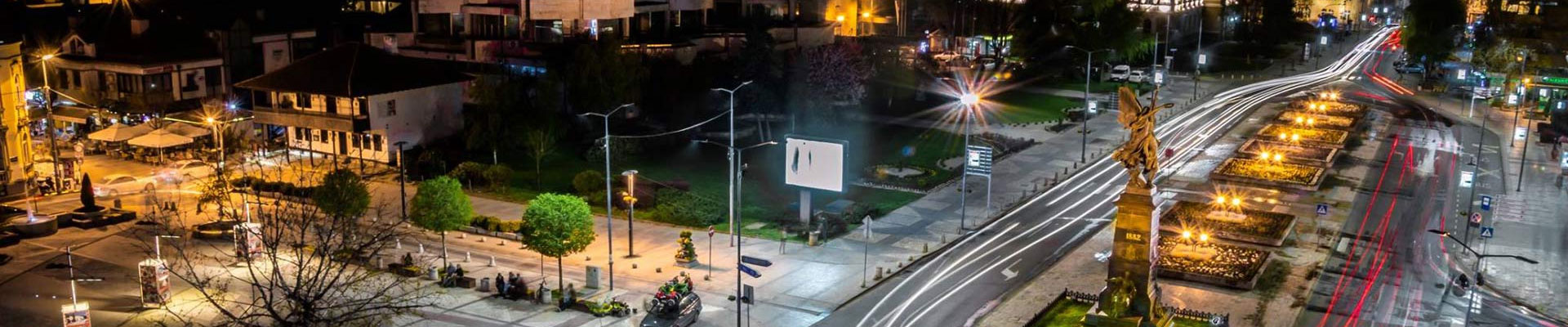
Krusevac was founded in 1371 by Prince Lazar of Serbia. The fact was first mentioned in a charter in which Lazar confirmed the previously-promised trading privileges for the people of Dubrovnik, in his fort in 1387. Back then, the city was the economic and cultural center of Serbia and the place from which the whole country was governed and organized into a complete state. It is believed that Krusevac was named after a round river stone named “krušac”, one of the main materials used for the building and construction of large portions of the city.
After the Battle of Kosovo in 1389, Krusevac became the capital of the vassal Serbia, firstly governed by Lazar’s spouse Milica, and later by their son, Crown-Prince Stefan, who moved the capital to Belgrade shortly after coming to power. While being an insurmountable obstacle for quite some time for the Ottoman forces, the city started falling into Ottoman hands in 1427, after the death of Crown-Prince Stefan. Djuradj Brankovic, Stefan’s nephew, took over the defense of the city from 1444, giving his utmost to repel the invading force, but ultimately the Ottoman took Brankovic prisoner in 1454, thus achieving full control over the city shortly after and renaming it into Alacahisar, which translates to “the colorful city”.
During the Austro-Turkish conflicts (dubbed Wars of the Holy League by the Ottomans), the city was momentarily freed from the Turkish grasp in 1689. The momentary liberation happened only twice in the 18th century: from 1737 to 1739, and again after a brief uprising that temporarily liberated a part of Serbia newly-named Koca’s Landscape (Kočina Krajina) in 1789. In the end, the city was returned to the Ottoman Empire as a result of the Treaty of Sistova, which marked the end of the Austro-Turkish conflict. It wasn’t until 1833 that Krusevac was completely liberated from the Ottoman Empire as a result of the Second Serbian Uprising of the Serbian Revolution. A period of rapid progress and improvement followed, which fastracked the city into becoming one of the largest regional centers of 19th-century Serbia.
During World War II, the Axis Power soldiers gathered and executed 1.642 local patriots by firing squad. After the war, the whole area was redesigned into a monument park that bears the name Slobodiste in their honor. (Slobodište, roughly translated as “a place of freedom”).